
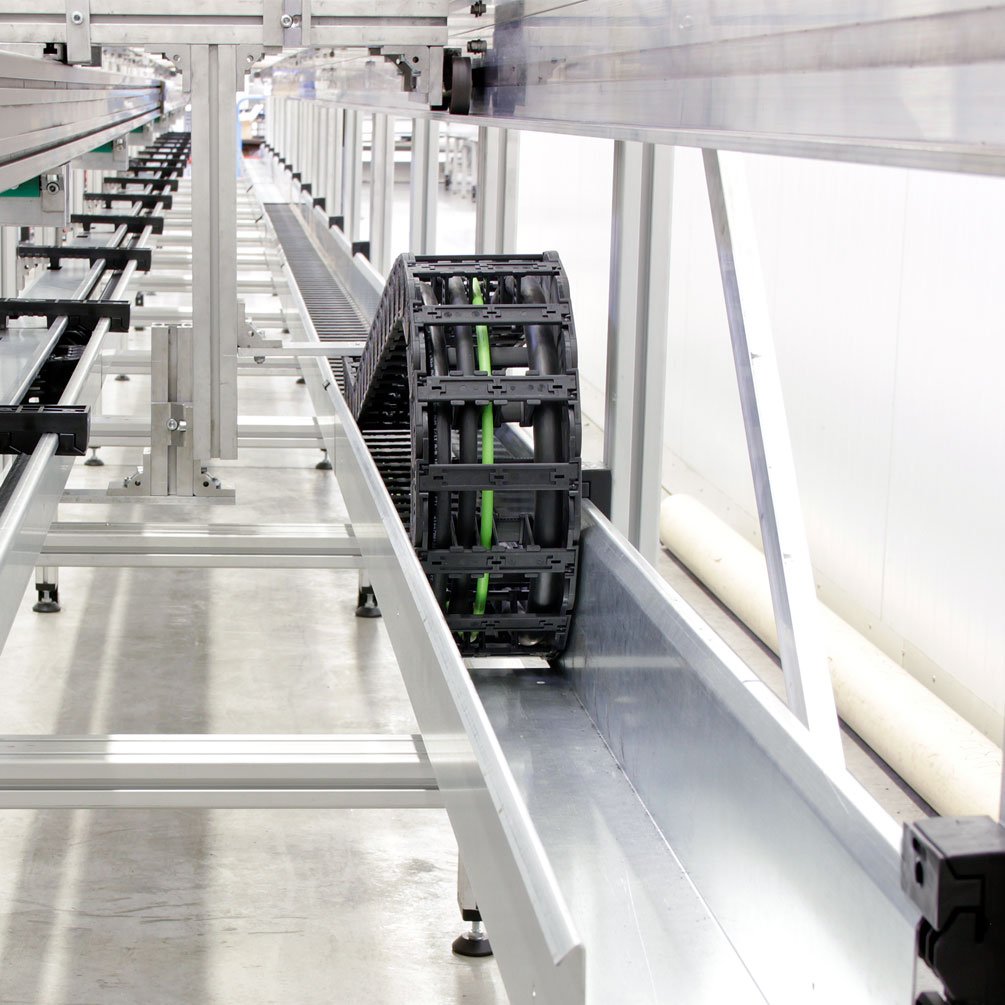
How to Choose the Right Cable Carrier
Cable carriers (also called energy chains or drag chains) are critical for protecting cables and hoses in moving machinery. Choosing the wrong one can lead to downtime, damaged cables, or unnecessary costs. In this guide, we’ll walk you through the key factors to help you select the perfect cable carrier for your application.
1. Understand Your Application
Start with the basics. Ask yourself:
- What machine or motion system will the carrier be used on?
- What is the travel distance and speed?
- Is the movement horizontal, vertical, or rotary?
- Indoor or outdoor environment?
Different applications—CNC machines, robotics, packaging lines, or automated storage systems—have very different requirements.
👉 Need help identifying your application?
Browse TrackCable cable carriers by industry in our webshop →
2. Measure the Required Inner Dimensions
Your carrier must fit your cables and hoses comfortably.
Key measurements:
- Inner height – tallest cable/connector + clearance
- Inner width – total cable bundle width
- Divider space – separation between cables
⚠️ Tip: Leave at least 10–20% extra space to allow airflow and reduce wear.
👉 Ready to size your carrier?
Shop TrackCable carriers by inner dimensions →
3. Calculate the Bend Radius
The bend radius of the carrier must be equal to or larger than the minimum bend radius of your cables.
If it’s too small:
- Cables fatigue early
- Signal loss may occur
- Hose damage is likely
Check cable specs or ask your supplier.
👉 Not sure about bend radius?
Explore TrackCable carriers with different bend radii →
4. Consider Load and Fill Weight
Each cable carrier has a maximum load capacity.
Think about:
- Cable weight per meter
- Hose weight when filled
- Acceleration forces
Heavy-duty applications may require reinforced or steel carriers.
5. Choose the Right Material
Different environments require different materials:
| Environment | Recommended Material |
|---|---|
| Standard factory | Plastic |
| Heavy-duty or hot environments | Steel |
| Outdoor/UV exposure | UV-resistant polymer |
| Cleanroom/food industry | Special hygienic materials |
👉 Find carriers by material type → Shop TrackCable
6. Check Mounting and Installation Options
Look for:
- Fixed vs pivoting brackets
- Easy-open crossbars
- Snap-open design for maintenance
This can save hours of installation time.
👉 See TrackCable installation accessories →
7. Plan for Future Expansion
Machines evolve. Add space for extra cables later.
Choosing a slightly larger carrier now can prevent costly redesigns later.
👉 Future-proof your setup → Browse expandable TrackCable carriers
8. When to Ask an Expert
If you’re unsure about:
- Long travel systems
- High-speed robotics
- Vertical motion
- Harsh environments
Our engineers can help.
👉 Get free advice from TrackCable → Contact us via the webshop
Final Thoughts
Choosing the right cable carrier is about matching application, size, load, material, and installation needs. A small investment in the correct carrier prevents downtime, extends cable life, and keeps your machines running smoothly.
Ready to Find Your Cable Carrier?
✔ Wide range of sizes
✔ Fast delivery across Europe
✔ Expert support
👉 Visit the TrackCable Webshop and Order Your Cable Carrier Today →

Add comment